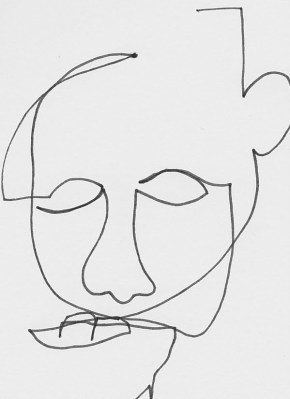
This new alliance—I say new, because until now scenery and costumes were linked only by factitious bonds—has given rise, in Parade, to a kind of surrealism, which I consider to be the point of departure for a whole series of manifestations of the New Spirit that is making itself felt today and that will certainly appeal to our best minds. We may expect it to bring about profound changes in our arts and manners through universal joyfulness, for it is only natural, after all, that they keep pace with scientific and industrial progress. (Apollinaire, 1917)
To begin with, three years before starting Surrealism, in 1917, a French poet called Guillaume Apollinaire made a description of Parade, a ballet performance. He stood out describing this ballet as “surrealistic”, while other artist described this performance as “realistic”.
Because of the new term “surrealism” that Apollinaire incorporated, three years later, the cultural movement of surrealism started. This art movement was born out of the consequences from the I World War when the writings and the technics from an obscure psychologist in Vienna, Sigmund Freud (1856-1939) started to be relevant treating the soldiers suffering from shell-shock. It was on 1921 when Andre Breton (1896-1966), a French writer, and poet, figured out the power of the damaged mind over the helpless body that Freud was using to treat those effects. Breton got inquisitive about what Freud’s called “unconscious mind” and he visited him.
Therefore, Andre Breton was a major member of the Dada group and one of the most relevant founders of Surrealism. The point of this artistic movement was a way of communicating one’s with the subconscious and liberate the imagination through the instantaneous “automatic writing” which you have to go through a process of paint, something that in the beginning it was not accepted.
Sigmund Freud, it was not the first one who studied the mind, but it was the first psychoanalyst to develop a theory about its basis and creation. These theories are found in Freud’s book called “The Interpretation of Dreams”.
“The interpretation of dreams is the via regia to a knowledge of the unconscious element in our physical life.”–Sigmund Freud
Freud’s discovery that the dream is the means by which the unconscious can be explored is undoubtedly the most revolutionary step forward in the entire history of psychology. Dreams, according to his theory, represent the hidden fulfillment of our unconscious wishes. Through them the inhibitions are released and tensions relaxed. The ability to interpret these manifestations of conflict in the human psyche opened a vast new realm of investigation, particularly invaluable in the treatment of neuroses. By his pioneer investigations into the world of dreams, Sigmund Freud created a transformation in our generation’s thinking.
To put it very simply, it was through Freud’s theory that we understood for the first time that we dream for a reason; that reason is to deal unconsciously with the problems the conscious mind can’t deal with. That theory meant that the mind obeyed its own rules. People set out to discover those rules and the reasons for them.
WEBS
https://en.wikipedia.org/wiki/The_Interpretation_of_Dreams
https://www.theartstory.org/movement-surrealism.htm
http://www.apsa.org/content/interpretation-dreams
https://arthistoryunstuffed.com/surrealism-freudian-theory/
https://sites.psu.edu/art101/2017/01/27/political-dream-art-surrealism/
http://www.oxfordartonline.com/page/dada-and-surrealism
https://www.tcf.ua.edu/Classes/Jbutler/T340/SurManifesto/ManifestoOfSurrealism.htm
http://www.arthistoryarchive.com/arthistory/surrealism/Origins-of-Surrealism.html
https://arthistoryunstuffed.com/surrealism-in-context/
https://en.wikipedia.org/wiki/Unconscious_mind
https://www.abebooks.co.uk/Mod-Lib-Interpretation-Dreams-Hardback-Sigmund/21947599615/bd
 Maria Francas